— Mineral Education
What Are Trace Minerals?
The seventy-plus elements present in ERYTH's whole-spectrum source — and why modern water no longer carries them all.
Trace minerals are elements present in natural mineral-rich water and whole foods. ERYTH is drawn from one of the oldest remaining mineral basins to return that spectrum to your daily routine.
01 — The two families
Macro minerals vs. trace minerals.
Macro Minerals
Needed in grams
- CaCalciumBone, nerve signaling
- MgMagnesium300+ enzyme reactions
- NaSodiumHydration, fluid balance
- KPotassiumHeart, muscle contraction
- ClChlorideStomach acid, fluid balance
Trace Minerals
Needed in micrograms
- ZnZincImmunity, skin, hormones
- FeIronOxygen transport
- CuCopperEnergy, connective tissue
- SeSeleniumAntioxidant defense
- CrChromiumGlucose metabolism
- IIodineThyroid function
- MnManganeseBone, enzyme cofactor
- MoMolybdenumDetoxification enzymes
…plus 60+ ultra-trace minerals (boron, lithium, vanadium, strontium, and more) found in ERYTH's whole-spectrum source.
02 — Why the spectrum matters
Small amounts. Full spectrum.
Trace minerals occur together in natural source water. ERYTH preserves that whole-spectrum relationship — the same ratio nature concentrated over millennia in the Great Salt Lake.
A daily trace mineral ritual is a simple way to add a broader mineral spectrum to the water you already drink, especially when your routine includes filtered water, travel, movement, or long days.
03 — Where a ritual fits
Daily moments that benefit from a full spectrum.

Active mornings
A mineral-rich start before work, movement, or travel.

Movement & sport
Sweat, heat, and long days pull more from your water than water puts back.

Focus blocks
Long calls, creative work, and deep concentration demand steady hydration.

Hair & skin rituals
Many people add minerals alongside their grooming and self-care routines.

Evening wind-down
A quiet mineral moment before rest and recovery.

Recovery days
Rest, stretching, and rehydration after a big effort.
04 — Forms of minerals
Ionic, chelated, colloidal —
what's the difference?
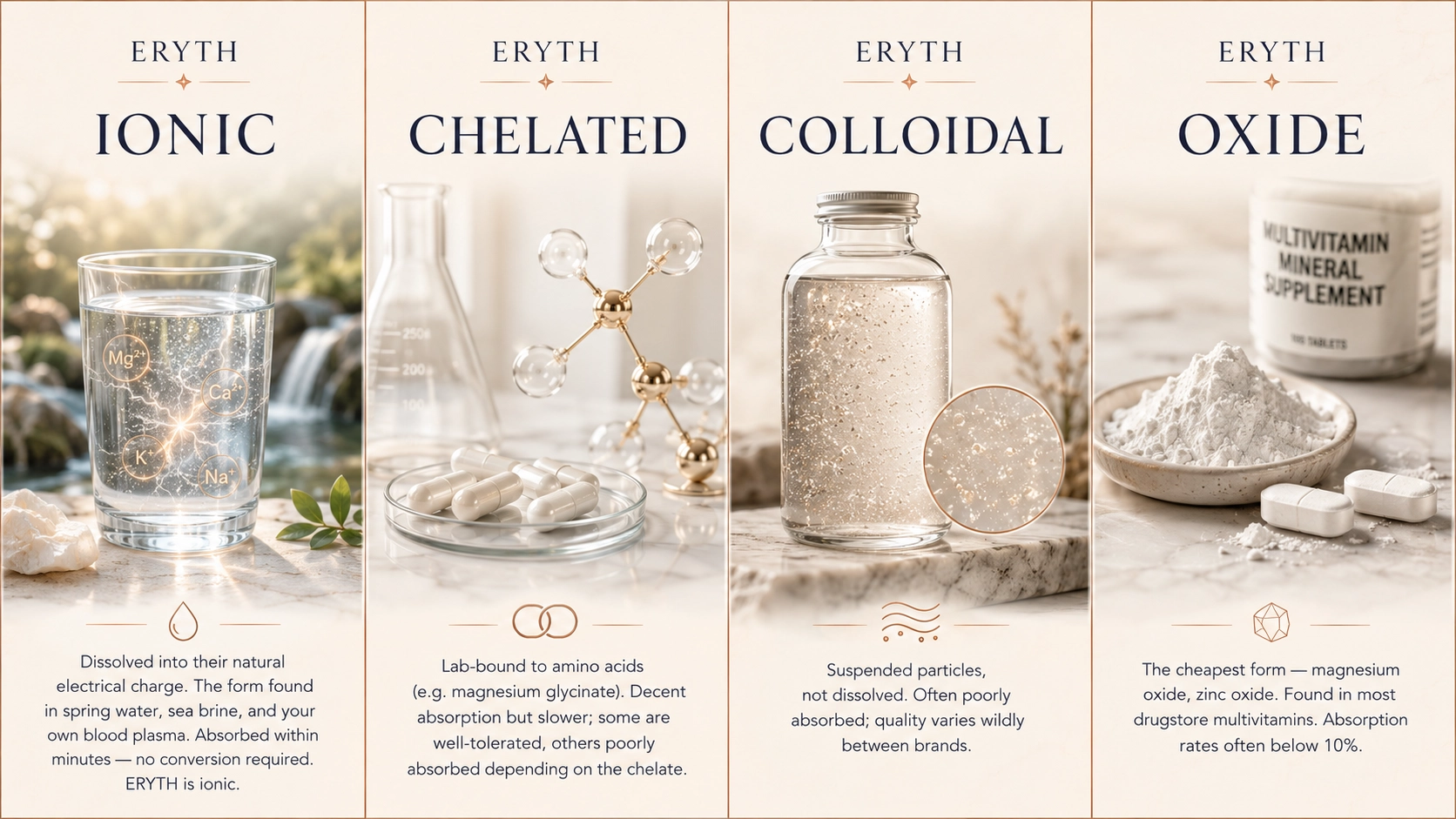
Ionic
Dissolved into their natural electrical charge. The form found in spring water, sea brine, and the Great Salt Lake source. ERYTH is ionic.
Chelated
Bound to amino acids in a lab. Common in capsules; form and tolerance vary by product.
Colloidal
Suspended particles rather than dissolved. Texture and quality vary widely between brands.
Oxide
Inexpensive powder form common in drugstore multivitamins. Often used as a filler mineral.
05 — FAQ
Common questions about
trace minerals.
Trace minerals are elements present in natural mineral-rich water and whole foods — measured in micrograms or milligrams. They include zinc, iron, copper, selenium, chromium, iodine, manganese, and dozens more.
Electrolytes are a small group of macro minerals (sodium, potassium, magnesium, calcium, chloride) that carry electrical charge in fluids. Trace minerals are a much wider category — 70+ elements present in smaller amounts in natural source waters and whole foods.
Trace mineral drops can be incorporated into a daily hydration routine by people looking for a convenient liquid mineral format alongside food and water. ERYTH focuses on simple mineral replenishment around everyday hydration, movement, travel, and wellness routines.
No. Most multivitamins contain isolated, lab-synthesized minerals in chelated or oxide forms. Whole-spectrum ionic trace minerals come from natural water sources and remain in the same dissolved form found in mineral-rich springs and sea brine.
Sea vegetables, mineral-rich spring water, organ meats, and unrefined sea salt are the deepest food sources. For most people, a daily ionic mineral concentrate (like ERYTH) is a simple, whole-spectrum addition to your water ritual.
Ready to build your mineral ritual?
See how a daily trace mineral routine fits into morning, movement, travel, recovery, and evening in The ERYTH Ritual.